Concatenated Divisibility
You are given an array of positive integers nums and a positive integer k.
You are given an array of positive integers nums and a positive integer k.
A permutation of nums is said to form a divisible concatenation if, when you concatenate the decimal representations of the numbers in the order specified by the permutation, the resulting number is divisible by k.
Return the lexicographically smallest permutation (when considered as a list of integers) that forms a divisible concatenation. If no such permutation exists, return an empty list.
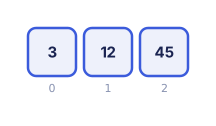
Example 1
Input: nums = [3,12,45], k = 5
Output: [3,12,45]
Explanation: The lexicographically smallest permutation that forms a divisible concatenation is [3,12,45] .
Example 2
Input: nums = [10,5], k = 10
Output: [5,10]
Explanation: The lexicographically smallest permutation that forms a divisible concatenation is [5,10] .
Example 3
Input: nums = [1,2,3], k = 5
Output: []
Explanation: Since no permutation of nums forms a valid divisible concatenation, return an empty list.
Constraints
- 1 <= nums.length <= 13
- 1 <= nums[i] <= 10^5
- 1 <= k <= 100
Hints
Companies
No companies reported yet.
Discussion
Sign in to join the discussion.
Loading discussion...
Test results
No test cases yet.