Count Different Palindromic Subsequences
Given a string s, return the number of different non-empty palindromic subsequences in s.
Given a string s, return the number of different non-empty palindromic subsequences in s. Since the answer may be very large, return it modulo 10^9 + 7.
A subsequence of a string is obtained by deleting zero or more characters from the string.
A sequence is palindromic if it is equal to the sequence reversed.
Two sequences a1, a2, ... and b1, b2, ... are different if there is some i for which ai != bi.
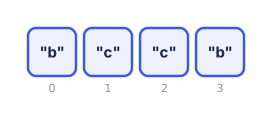
Example 1
Input: s = "bccb"
Output: 6
Explanation: The 6 different non-empty palindromic subsequences are 'b', 'c', 'bb', 'cc', 'bcb', 'bccb'. Note that 'bcb' is counted only once, even though it occurs twice.
Example 2
Input: s = "abcdabcdabcdabcdabcdabcdabcdabcddcbadcbadcbadcbadcbadcbadcbadcba"
Output: 104860361
Explanation: There are 3104860382 different non-empty palindromic subsequences, which is 104860361 modulo 10^9 + 7.
Constraints
- 1 <= s.length <= 1000
- s[i] is either 'a', 'b', 'c', or 'd'.
Hints
Companies
No companies reported yet.
Discussion
Sign in to join the discussion.
Loading discussion...
Test results
No test cases yet.