Count Fertile Pyramids in a Land
A farmer has a rectangular grid of land with m rows and n columns that can be divided into unit cells.
A farmer has a rectangular grid of land with m rows and n columns that can be divided into unit cells. Each cell is either fertile (represented by a 1) or barren (represented by a 0). All cells outside the grid are considered barren.
A pyramidal plot of land can be defined as a set of cells with the following criteria:
An inverse pyramidal plot of land can be defined as a set of cells with similar criteria:
Some examples of valid and invalid pyramidal (and inverse pyramidal) plots are shown below. Black cells indicate fertile cells.
Given a 0-indexed m x n binary matrix grid representing the farmland, return the total number of pyramidal and inverse pyramidal plots that can be found in grid.
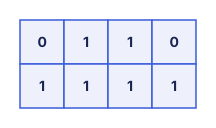
Example 1
Input: grid = [[0,1,1,0],[1,1,1,1]]
Output: 2
Explanation: The 2 possible pyramidal plots are shown in blue and red respectively. There are no inverse pyramidal plots in this grid. Hence total number of pyramidal and inverse pyramidal plots is 2 + 0 = 2.
Example 2
Input: grid = [[1,1,1],[1,1,1]]
Output: 2
Explanation: The pyramidal plot is shown in blue, and the inverse pyramidal plot is shown in red. Hence the total number of plots is 1 + 1 = 2.
Example 3
Input: grid = [[1,1,1,1,0],[1,1,1,1,1],[1,1,1,1,1],[0,1,0,0,1]]
Output: 13
Explanation: There are 7 pyramidal plots, 3 of which are shown in the 2nd and 3rd figures. There are 6 inverse pyramidal plots, 2 of which are shown in the last figure. The total number of plots is 7 + 6 = 13.
Constraints
- m == grid.length
- n == grid[i].length
- 1 <= m, n <= 1000
- 1 <= m * n <= 10^5
- grid[i][j] is either 0 or 1.
Hints
Companies
No companies reported yet.
Discussion
Sign in to join the discussion.
Loading discussion...
Test results
No test cases yet.