Count K-Reducible Numbers Less Than N
You are given a binary string s representing a number n in its binary form.
You are given a binary string s representing a number n in its binary form.
You are also given an integer k.
An integer x is called k-reducible if performing the following operation at most k times reduces it to 1:
For example, the binary representation of 6 is "110". Applying the operation once reduces it to 2 (since "110" has two set bits). Applying the operation again to 2 (binary "10") reduces it to 1 (since "10" has one set bit).
Return an integer denoting the number of positive integers less than n that are k-reducible.
Since the answer may be too large, return it modulo 10^9 + 7.
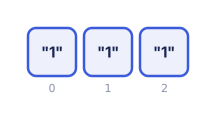
Example 1
Input: s = "111", k = 1
Output: 3
Explanation: n = 7 . The 1-reducible integers less than 7 are 1, 2, and 4.
Example 2
Input: s = "1000", k = 2
Output: 6
Explanation: n = 8 . The 2-reducible integers less than 8 are 1, 2, 3, 4, 5, and 6.
Example 3
Input: s = "1", k = 3
Output: 0
Explanation: There are no positive integers less than n = 1 , so the answer is 0.
Constraints
- 1 <= s.length <= 800
- s has no leading zeros.
- s consists only of the characters '0' and '1'.
- 1 <= k <= 5
Hints
Companies
No companies reported yet.
Discussion
Sign in to join the discussion.
Loading discussion...
Test results
No test cases yet.