Count Number of Maximum Bitwise-OR Subsets
Given an integer array nums, find the maximum possible bitwise OR of a subset of nums and return the number of different non-empty subsets with the maximum bitwise OR.
Given an integer array nums, find the maximum possible bitwise OR of a subset of nums and return the number of different non-empty subsets with the maximum bitwise OR.
An array a is a subset of an array b if a can be obtained from b by deleting some (possibly zero) elements of b. Two subsets are considered different if the indices of the elements chosen are different.
The bitwise OR of an array a is equal to a[0] OR a[1] OR ... OR a[a.length - 1] (0-indexed).
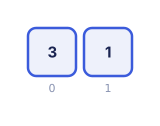
Example 1
Input: nums = [3,1]
Output: 2
Explanation: The maximum possible bitwise OR of a subset is 3. There are 2 subsets with a bitwise OR of 3: - [3] - [3,1]
Example 2
Input: nums = [2,2,2]
Output: 7
Explanation: All non-empty subsets of [2,2,2] have a bitwise OR of 2. There are 23 - 1 = 7 total subsets.
Example 3
Input: nums = [3,2,1,5]
Output: 6
Explanation: The maximum possible bitwise OR of a subset is 7. There are 6 subsets with a bitwise OR of 7: - [3,5] - [3,1,5] - [3,2,5] - [3,2,1,5] - [2,5] - [2,1,5]
Constraints
- 1 <= nums.length <= 16
- 1 <= nums[i] <= 10^5
Hints
Companies
No companies reported yet.
Discussion
Sign in to join the discussion.
Loading discussion...
Test results
No test cases yet.