Count Tested Devices After Test Operations
You are given a 0-indexed integer array batteryPercentages having length n, denoting the battery percentages of n 0-indexed devices.
You are given a 0-indexed integer array batteryPercentages having length n, denoting the battery percentages of n 0-indexed devices.
Your task is to test each device i in order from 0 to n - 1, by performing the following test operations:
Return an integer denoting the number of devices that will be tested after performing the test operations in order.
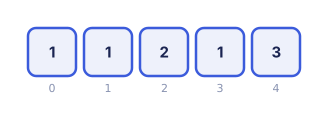
Example 1
Input: batteryPercentages = [1,1,2,1,3]
Output: 3
Explanation: Performing the test operations in order starting from device 0: At device 0, batteryPercentages[0] > 0, so there is now 1 tested device, and batteryPercentages becomes [1,0,1,0,2]. At device 1, batteryPercentages[1] == 0, so we move to the next device without testing. At device 2, batteryPercentages[2] > 0, so there are now 2 tested devices, and batteryPercentages becomes [1,0,1,0,1]. At device 3, batteryPercentages[3] == 0, so we move to the next device without testing. At device 4, batteryPercentages[4] > 0, so there are now 3 tested devices, and batteryPercentages stays the same. So, the answer is 3.
Example 2
Input: batteryPercentages = [0,1,2]
Output: 2
Explanation: Performing the test operations in order starting from device 0: At device 0, batteryPercentages[0] == 0, so we move to the next device without testing. At device 1, batteryPercentages[1] > 0, so there is now 1 tested device, and batteryPercentages becomes [0,1,1]. At device 2, batteryPercentages[2] > 0, so there are now 2 tested devices, and batteryPercentages stays the same. So, the answer is 2.
Constraints
- 1 <= n == batteryPercentages.length <= 100
- 0 <= batteryPercentages[i] <= 100
Hints
Companies
No companies reported yet.
Discussion
Sign in to join the discussion.
Loading discussion...
Test results
No test cases yet.