Count the Hidden Sequences
You are given a 0-indexed array of n integers differences, which describes the differences between each pair of consecutive integers of a hidden sequence of length (n + 1).
You are given a 0-indexed array of n integers differences, which describes the differences between each pair of consecutive integers of a hidden sequence of length (n + 1). More formally, call the hidden sequence hidden, then we have that differences[i] = hidden[i + 1] - hidden[i].
You are further given two integers lower and upper that describe the inclusive range of values [lower, upper] that the hidden sequence can contain.
Return the number of possible hidden sequences there are. If there are no possible sequences, return 0.
Example 1
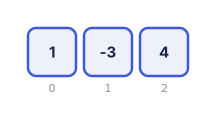
Input: differences = [1,-3,4], lower = 1, upper = 6
Output: 2
Explanation: The possible hidden sequences are: - [3, 4, 1, 5] - [4, 5, 2, 6] Thus, we return 2.
Example 2
Input: differences = [3,-4,5,1,-2], lower = -4, upper = 5
Output: 4
Explanation: The possible hidden sequences are: - [-3, 0, -4, 1, 2, 0] - [-2, 1, -3, 2, 3, 1] - [-1, 2, -2, 3, 4, 2] - [0, 3, -1, 4, 5, 3] Thus, we return 4.
Example 3
Input: differences = [4,-7,2], lower = 3, upper = 6
Output: 0
Explanation: There are no possible hidden sequences. Thus, we return 0.
Constraints
- n == differences.length
- 1 <= n <= 10^5
- -10^5 <= differences[i] <= 10^5
- -10^5 <= lower <= upper <= 10^5
Hints
Companies
No companies reported yet.
Discussion
Sign in to join the discussion.
Loading discussion...
Test results
No test cases yet.