Final Value of Variable After Performing Operations
There is a programming language with only four operations and one variable X: Initially, the value of X is 0.
There is a programming language with only four operations and one variable X:
Initially, the value of X is 0.
Given an array of strings operations containing a list of operations, return the final value of X after performing all the operations.
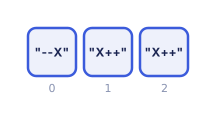
Example 1
Input: operations = ["--X","X++","X++"]
Output: 1
Explanation: The operations are performed as follows: Initially, X = 0. --X: X is decremented by 1, X = 0 - 1 = -1. X++: X is incremented by 1, X = -1 + 1 = 0. X++: X is incremented by 1, X = 0 + 1 = 1.
Example 2
Input: operations = ["++X","++X","X++"]
Output: 3
Explanation: The operations are performed as follows: Initially, X = 0. ++X: X is incremented by 1, X = 0 + 1 = 1. ++X: X is incremented by 1, X = 1 + 1 = 2. X++: X is incremented by 1, X = 2 + 1 = 3.
Example 3
Input: operations = ["X++","++X","--X","X--"]
Output: 0
Explanation: The operations are performed as follows: Initially, X = 0. X++: X is incremented by 1, X = 0 + 1 = 1. ++X: X is incremented by 1, X = 1 + 1 = 2. --X: X is decremented by 1, X = 2 - 1 = 1. X--: X is decremented by 1, X = 1 - 1 = 0.
Constraints
- 1 <= operations.length <= 100
- operations[i] will be either "++X", "X++", "--X", or "X--".
Hints
Companies
No companies reported yet.
Discussion
Sign in to join the discussion.
Loading discussion...
Test results
No test cases yet.