Find the K-or of an Array
You are given an integer array nums, and an integer k.
You are given an integer array nums, and an integer k. Let's introduce K-or operation by extending the standard bitwise OR. In K-or, a bit position in the result is set to 1 if at least k numbers in nums have a 1 in that position.
Return the K-or of nums.
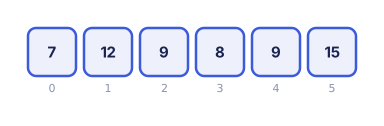
Example 1
Input: nums = [7,12,9,8,9,15], k = 4
Output: 9
Explanation: Represent numbers in binary: Bit 0 is set in 7, 9, 9, and 15. Bit 3 is set in 12, 9, 8, 9, and 15. Only bits 0 and 3 qualify. The result is (1001) 2 = 9 .
Example 2
Input: nums = [2,12,1,11,4,5], k = 6
Output: 0
Explanation: No bit appears as 1 in all six array numbers, as required for K-or with k = 6 . Thus, the result is 0.
Example 3
Input: nums = [10,8,5,9,11,6,8], k = 1
Output: 15
Explanation: Since k == 1 , the 1-or of the array is equal to the bitwise OR of all its elements. Hence, the answer is 10 OR 8 OR 5 OR 9 OR 11 OR 6 OR 8 = 15 .
Constraints
- 1 <= nums.length <= 50
- 0 <= nums[i] < 231
- 1 <= k <= nums.length
Hints
Companies
No companies reported yet.
Discussion
Sign in to join the discussion.
Loading discussion...
Test results
No test cases yet.