Jump Game VI
You are given a 0-indexed integer array nums and an integer k.
You are given a 0-indexed integer array nums and an integer k.
You are initially standing at index 0. In one move, you can jump at most k steps forward without going outside the boundaries of the array. That is, you can jump from index i to any index in the range [i + 1, min(n - 1, i + k)] inclusive.
You want to reach the last index of the array (index n - 1). Your score is the sum of all nums[j] for each index j you visited in the array.
Return the maximum score you can get.
Example 1
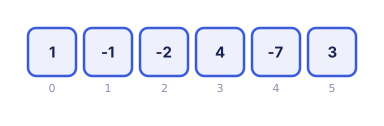
Input: nums = [1,-1,-2,4,-7,3], k = 2
Output: 7
Explanation: You can choose your jumps forming the subsequence [1,-1,4,3] (underlined above). The sum is 7.
Example 2
Input: nums = [10,-5,-2,4,0,3], k = 3
Output: 17
Explanation: You can choose your jumps forming the subsequence [10,4,3] (underlined above). The sum is 17.
Example 3
Input: nums = [1,-5,-20,4,-1,3,-6,-3], k = 2
Output: 0
Constraints
- 1 <= nums.length, k <= 10^5
- -10^4 <= nums[i] <= 10^4
Hints
Companies
No companies reported yet.
Discussion
Sign in to join the discussion.
Loading discussion...
Test results
No test cases yet.