K Divisible Elements Subarrays
Given an integer array nums and two integers k and p, return the number of distinct subarrays, which have at most k elements that are divisible by p.
Given an integer array nums and two integers k and p, return the number of distinct subarrays, which have at most k elements that are divisible by p.
Two arrays nums1 and nums2 are said to be distinct if:
A subarray is defined as a non-empty contiguous sequence of elements in an array.
Follow up:
Can you solve this problem in O(n2) time complexity?
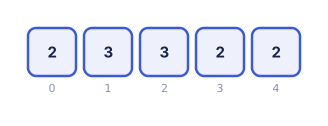
Example 1
Input: nums = [2,3,3,2,2], k = 2, p = 2
Output: 11
Explanation: The elements at indices 0, 3, and 4 are divisible by p = 2. The 11 distinct subarrays which have at most k = 2 elements divisible by 2 are: [2], [2,3], [2,3,3], [2,3,3,2], [3], [3,3], [3,3,2], [3,3,2,2], [3,2], [3,2,2], and [2,2]. Note that the subarrays [2] and [3] occur more than once in nums, but they should each be counted only once. The subarray [2,3,3,2,2] should not be counted because it has 3 elements that are divisible by 2.
Example 2
Input: nums = [1,2,3,4], k = 4, p = 1
Output: 10
Explanation: All element of nums are divisible by p = 1. Also, every subarray of nums will have at most 4 elements that are divisible by 1. Since all subarrays are distinct, the total number of subarrays satisfying all the constraints is 10.
Constraints
- 1 <= nums.length <= 200
- 1 <= nums[i], p <= 200
- 1 <= k <= nums.length
Hints
Companies
No companies reported yet.
Discussion
Sign in to join the discussion.
Loading discussion...
Test results
No test cases yet.