Largest Number After Mutating Substring
You are given a string num, which represents a large integer.
You are given a string num, which represents a large integer. You are also given a 0-indexed integer array change of length 10 that maps each digit 0-9 to another digit. More formally, digit d maps to digit change[d].
You may choose to mutate a single substring of num. To mutate a substring, replace each digit num[i] with the digit it maps to in change (i.e. replace num[i] with change[num[i]]).
Return a string representing the largest possible integer after mutating (or choosing not to) a single substring of num.
A substring is a contiguous sequence of characters within the string.
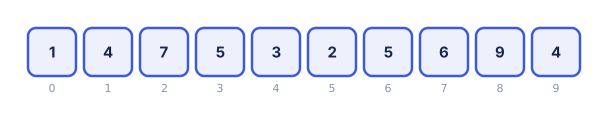
Example 1
Input: num = "132", change = [9,8,5,0,3,6,4,2,6,8]
Output: "832"
Explanation: Replace the substring "1": - 1 maps to change[1] = 8. Thus, "132" becomes "832". "832" is the largest number that can be created, so return it.
Example 2
Input: num = "021", change = [9,4,3,5,7,2,1,9,0,6]
Output: "934"
Explanation: Replace the substring "021": - 0 maps to change[0] = 9. - 2 maps to change[2] = 3. - 1 maps to change[1] = 4. Thus, "021" becomes "934". "934" is the largest number that can be created, so return it.
Example 3
Input: num = "5", change = [1,4,7,5,3,2,5,6,9,4]
Output: "5"
Explanation: "5" is already the largest number that can be created, so return it.
Constraints
- 1 <= num.length <= 10^5
- num consists of only digits 0-9.
- change.length == 10
- 0 <= change[d] <= 9
Hints
Companies
No companies reported yet.
Discussion
Sign in to join the discussion.
Loading discussion...
Test results
No test cases yet.