Longest Continuous Increasing Subsequence
Given an unsorted array of integers nums, return the length of the longest continuous increasing subsequence (i.e.
Given an unsorted array of integers nums, return the length of the longest continuous increasing subsequence (i.e. subarray). The subsequence must be strictly increasing.
A continuous increasing subsequence is defined by two indices l and r (l < r) such that it is [nums[l], nums[l + 1], ..., nums[r - 1], nums[r]] and for each l <= i < r, nums[i] < nums[i + 1].
Example 1
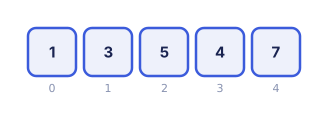
Input: nums = [1,3,5,4,7]
Output: 3
Explanation: The longest continuous increasing subsequence is [1,3,5] with length 3. Even though [1,3,5,7] is an increasing subsequence, it is not continuous as elements 5 and 7 are separated by element 4.
Example 2
Input: nums = [2,2,2,2,2]
Output: 1
Explanation: The longest continuous increasing subsequence is [2] with length 1. Note that it must be strictly increasing.
Constraints
- 1 <= nums.length <= 10^4
- -10^9 <= nums[i] <= 10^9
Hints
No hints yet.
Companies
No companies reported yet.
Discussion
Sign in to join the discussion.
Loading discussion...
Test results
No test cases yet.