Longest Continuous Subarray With Absolute Diff Less Than or Equal to Limit
Given an array of integers nums and an integer limit, return the size of the longest non-empty subarray such that the absolute difference between any two elements of this subarray...
Given an array of integers nums and an integer limit, return the size of the longest non-empty subarray such that the absolute difference between any two elements of this subarray is less than or equal to limit.
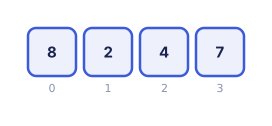
Example 1
Input: nums = [8,2,4,7], limit = 4
Output: 2
Explanation: All subarrays are: [8] with maximum absolute diff |8-8| = 0 <= 4. [8,2] with maximum absolute diff |8-2| = 6 > 4. [8,2,4] with maximum absolute diff |8-2| = 6 > 4. [8,2,4,7] with maximum absolute diff |8-2| = 6 > 4. [2] with maximum absolute diff |2-2| = 0 <= 4. [2,4] with maximum absolute diff |2-4| = 2 <= 4. [2,4,7] with maximum absolute diff |2-7| = 5 > 4. [4] with maximum absolute diff |4-4| = 0 <= 4. [4,7] with maximum absolute diff |4-7| = 3 <= 4. [7] with maximum absolute diff |7-7| = 0 <= 4. Therefore, the size of the longest subarray is 2.
Example 2
Input: nums = [10,1,2,4,7,2], limit = 5
Output: 4
Explanation: The subarray [2,4,7,2] is the longest since the maximum absolute diff is |2-7| = 5 <= 5.
Example 3
Input: nums = [4,2,2,2,4,4,2,2], limit = 0
Output: 3
Constraints
- 1 <= nums.length <= 10^5
- 1 <= nums[i] <= 10^9
- 0 <= limit <= 10^9
Hints
Companies
No companies reported yet.
Discussion
Sign in to join the discussion.
Loading discussion...
Test results
No test cases yet.