Longest Strictly Increasing or Strictly Decreasing Subarray
You are given an array of integers nums.
You are given an array of integers nums. Return the length of the longest subarray of nums which is either strictly increasing or strictly decreasing.
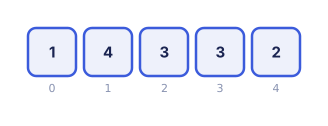
Example 1
Input: nums = [1,4,3,3,2]
Output: 2
Explanation: The strictly increasing subarrays of nums are [1] , [2] , [3] , [3] , [4] , and [1,4] . The strictly decreasing subarrays of nums are [1] , [2] , [3] , [3] , [4] , [3,2] , and [4,3] . Hence, we return 2 .
Example 2
Input: nums = [3,3,3,3]
Output: 1
Explanation: The strictly increasing subarrays of nums are [3] , [3] , [3] , and [3] . The strictly decreasing subarrays of nums are [3] , [3] , [3] , and [3] . Hence, we return 1 .
Example 3
Input: nums = [3,2,1]
Output: 3
Explanation: The strictly increasing subarrays of nums are [3] , [2] , and [1] . The strictly decreasing subarrays of nums are [3] , [2] , [1] , [3,2] , [2,1] , and [3,2,1] . Hence, we return 3 .
Constraints
- 1 <= nums.length <= 50
- 1 <= nums[i] <= 50
Hints
No hints yet.
Companies
No companies reported yet.
Discussion
Sign in to join the discussion.
Loading discussion...
Test results
No test cases yet.