Maximize the Number of Partitions After Operations
You are given a string s and an integer k.
You are given a string s and an integer k.
First, you are allowed to change at most one index in s to another lowercase English letter.
After that, do the following partitioning operation until s is empty:
Return an integer denoting the maximum number of resulting partitions after the operations by optimally choosing at most one index to change.
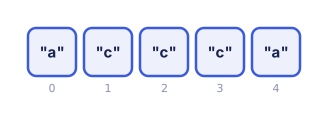
Example 1
Input: s = "accca", k = 2
Output: 3
Explanation: The optimal way is to change s[2] to something other than a and c, for example, b. then it becomes "acbca" . Then we perform the operations: Doing the operations, the string is divided into 3 partitions, so the answer is 3.
Example 2
Input: s = "aabaab", k = 3
Output: 1
Explanation: Initially s contains 2 distinct characters, so whichever character we change, it will contain at most 3 distinct characters, so the longest prefix with at most 3 distinct characters would always be all of it, therefore the answer is 1.
Example 3
Input: s = "xxyz", k = 1
Output: 4
Explanation: The optimal way is to change s[0] or s[1] to something other than characters in s , for example, to change s[0] to w . Then s becomes "wxyz" , which consists of 4 distinct characters, so as k is 1, it will divide into 4 partitions.
Constraints
- 1 <= s.length <= 10^4
- s consists only of lowercase English letters.
- 1 <= k <= 26
Hints
Companies
No companies reported yet.
Discussion
Sign in to join the discussion.
Loading discussion...
Test results
No test cases yet.