Maximum Alternating Subsequence Sum
The alternating sum of a 0-indexed array is defined as the sum of the elements at even indices minus the sum of the elements at odd indices.
The alternating sum of a 0-indexed array is defined as the sum of the elements at even indices minus the sum of the elements at odd indices.
Given an array nums, return the maximum alternating sum of any subsequence of nums (after reindexing the elements of the subsequence).
A subsequence of an array is a new array generated from the original array by deleting some elements (possibly none) without changing the remaining elements' relative order. For example, [2,7,4] is a subsequence of [4,2,3,7,2,1,4] (the underlined elements), while [2,4,2] is not.
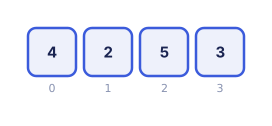
Example 1
Input: nums = [4,2,5,3]
Output: 7
Explanation: It is optimal to choose the subsequence [4,2,5] with alternating sum (4 + 5) - 2 = 7.
Example 2
Input: nums = [5,6,7,8]
Output: 8
Explanation: It is optimal to choose the subsequence [8] with alternating sum 8.
Example 3
Input: nums = [6,2,1,2,4,5]
Output: 10
Explanation: It is optimal to choose the subsequence [6,1,5] with alternating sum (6 + 5) - 1 = 10.
Constraints
- 1 <= nums.length <= 10^5
- 1 <= nums[i] <= 10^5
Hints
Companies
No companies reported yet.
Discussion
Sign in to join the discussion.
Loading discussion...
Test results
No test cases yet.