Maximum Number of Removable Characters
You are given two strings s and p where p is a subsequence of s.
You are given two strings s and p where p is a subsequence of s. You are also given a distinct 0-indexed integer array removable containing a subset of indices of s (s is also 0-indexed).
You want to choose an integer k (0 <= k <= removable.length) such that, after removing k characters from s using the first k indices in removable, p is still a subsequence of s. More formally, you will mark the character at s[removable[i]] for each 0 <= i < k, then remove all marked characters and check if p is still a subsequence.
Return the maximum k you can choose such that p is still a subsequence of s after the removals.
A subsequence of a string is a new string generated from the original string with some characters (can be none) deleted without changing the relative order of the remaining characters.
Example 1
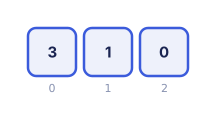
Input: s = "abcacb", p = "ab", removable = [3,1,0]
Output: 2
Explanation: After removing the characters at indices 3 and 1, "abcacb" becomes "accb". "ab" is a subsequence of "accb". If we remove the characters at indices 3, 1, and 0, "abcacb" becomes "ccb", and "ab" is no longer a subsequence. Hence, the maximum k is 2.
Example 2
Input: s = "abcbddddd", p = "abcd", removable = [3,2,1,4,5,6]
Output: 1
Explanation: After removing the character at index 3, "abcbddddd" becomes "abcddddd". "abcd" is a subsequence of "abcddddd".
Example 3
Input: s = "abcab", p = "abc", removable = [0,1,2,3,4]
Output: 0
Explanation: If you remove the first index in the array removable, "abc" is no longer a subsequence.
Constraints
- 1 <= p.length <= s.length <= 10^5
- 0 <= removable.length < s.length
- 0 <= removable[i] < s.length
- p is a subsequence of s.
- s and p both consist of lowercase English letters.
- The elements in removable are distinct.
Hints
Companies
No companies reported yet.
Discussion
Sign in to join the discussion.
Loading discussion...
Test results
No test cases yet.