Maximum Possible Number by Binary Concatenation
You are given an array of integers nums of size 3.
You are given an array of integers nums of size 3.
Return the maximum possible number whose binary representation can be formed by concatenating the binary representation of all elements in nums in some order.
Note that the binary representation of any number does not contain leading zeros.
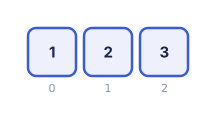
Example 1
Input: nums = [1,2,3]
Output: 30
Explanation: Concatenate the numbers in the order [3, 1, 2] to get the result "11110" , which is the binary representation of 30.
Example 2
Input: nums = [2,8,16]
Output: 1296
Explanation: Concatenate the numbers in the order [2, 8, 16] to get the result "10100010000" , which is the binary representation of 1296.
Constraints
- nums.length == 3
- 1 <= nums[i] <= 127
Hints
Companies
No companies reported yet.
Discussion
Sign in to join the discussion.
Loading discussion...
Test results
No test cases yet.