Maximum Product of First and Last Elements of a Subsequence
You are given an integer array nums and an integer m.
You are given an integer array nums and an integer m.
Return the maximum product of the first and last elements of any subsequence of nums of size m.
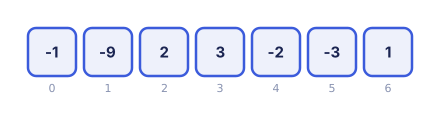
Example 1
Input: nums = [-1,-9,2,3,-2,-3,1], m = 1
Output: 81
Explanation: The subsequence [-9] has the largest product of the first and last elements: -9 * -9 = 81 . Therefore, the answer is 81.
Example 2
Input: nums = [1,3,-5,5,6,-4], m = 3
Output: 20
Explanation: The subsequence [-5, 6, -4] has the largest product of the first and last elements.
Example 3
Input: nums = [2,-1,2,-6,5,2,-5,7], m = 2
Output: 35
Explanation: The subsequence [5, 7] has the largest product of the first and last elements.
Constraints
- 1 <= nums.length <= 10^5
- -10^5 <= nums[i] <= 10^5
- 1 <= m <= nums.length
Hints
Companies
No companies reported yet.
Discussion
Sign in to join the discussion.
Loading discussion...
Test results
No test cases yet.