Maximum Spending After Buying Items
You are given a 0-indexed m * n integer matrix values, representing the values of m * n different items in m different shops.
You are given a 0-indexed m * n integer matrix values, representing the values of m * n different items in m different shops. Each shop has n items where the jth item in the ith shop has a value of values[i][j]. Additionally, the items in the ith shop are sorted in non-increasing order of value. That is, values[i][j] >= values[i][j + 1] for all 0 <= j < n - 1.
On each day, you would like to buy a single item from one of the shops. Specifically, On the dth day you can:
Note that all items are pairwise different. For example, if you have bought item 0 from shop 1, you can still buy item 0 from any other shop.
Return the maximum amount of money that can be spent on buying all m * n products.
Example 1
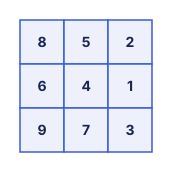
Input: values = [[8,5,2],[6,4,1],[9,7,3]]
Output: 285
Explanation: On the first day, we buy product 2 from shop 1 for a price of values[1][2] * 1 = 1. On the second day, we buy product 2 from shop 0 for a price of values[0][2] * 2 = 4. On the third day, we buy product 2 from shop 2 for a price of values[2][2] * 3 = 9. On the fourth day, we buy product 1 from shop 1 for a price of values[1][1] * 4 = 16. On the fifth day, we buy product 1 from shop 0 for a price of values[0][1] * 5 = 25. On the sixth day, we buy product 0 from shop 1 for a price of values[1][0] * 6 = 36. On the seventh day, we buy product 1 from shop 2 for a price of values[2][1] * 7 = 49. On the eighth day, we buy product 0 from shop 0 for a price of values[0][0] * 8 = 64. On the ninth day, we buy product 0 from shop 2 for a price of values[2][0] * 9 = 81. Hence, our total spending is equal to 285. It can be shown that 285 is the maximum amount of money that can be spent buying all m * n products.
Example 2
Input: values = [[10,8,6,4,2],[9,7,5,3,2]]
Output: 386
Explanation: On the first day, we buy product 4 from shop 0 for a price of values[0][4] * 1 = 2. On the second day, we buy product 4 from shop 1 for a price of values[1][4] * 2 = 4. On the third day, we buy product 3 from shop 1 for a price of values[1][3] * 3 = 9. On the fourth day, we buy product 3 from shop 0 for a price of values[0][3] * 4 = 16. On the fifth day, we buy product 2 from shop 1 for a price of values[1][2] * 5 = 25. On the sixth day, we buy product 2 from shop 0 for a price of values[0][2] * 6 = 36. On the seventh day, we buy product 1 from shop 1 for a price of values[1][1] * 7 = 49. On the eighth day, we buy product 1 from shop 0 for a price of values[0][1] * 8 = 64 On the ninth day, we buy product 0 from shop 1 for a price of values[1][0] * 9 = 81. On the tenth day, we buy product 0 from shop 0 for a price of values[0][0] * 10 = 100. Hence, our total spending is equal to 386. It can be shown that 386 is the maximum amount of money that can be spent buying all m * n products.
Constraints
- 1 <= m == values.length <= 10
- 1 <= n == values[i].length <= 10^4
- 1 <= values[i][j] <= 10^6
- values[i] are sorted in non-increasing order.
Hints
Companies
No companies reported yet.
Discussion
Sign in to join the discussion.
Loading discussion...
Test results
No test cases yet.