Maximum Subarray Min-Product
The min-product of an array is equal to the minimum value in the array multiplied by the array's sum.
The min-product of an array is equal to the minimum value in the array multiplied by the array's sum.
Given an array of integers nums, return the maximum min-product of any non-empty subarray of nums. Since the answer may be large, return it modulo 10^9 + 7.
Note that the min-product should be maximized before performing the modulo operation. Testcases are generated such that the maximum min-product without modulo will fit in a 64-bit signed integer.
A subarray is a contiguous part of an array.
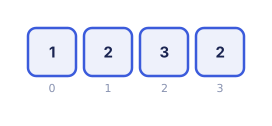
Example 1
Input: nums = [1,2,3,2]
Output: 14
Explanation: The maximum min-product is achieved with the subarray [2,3,2] (minimum value is 2). 2 * (2+3+2) = 2 * 7 = 14.
Example 2
Input: nums = [2,3,3,1,2]
Output: 18
Explanation: The maximum min-product is achieved with the subarray [3,3] (minimum value is 3). 3 * (3+3) = 3 * 6 = 18.
Example 3
Input: nums = [3,1,5,6,4,2]
Output: 60
Explanation: The maximum min-product is achieved with the subarray [5,6,4] (minimum value is 4). 4 * (5+6+4) = 4 * 15 = 60.
Constraints
- 1 <= nums.length <= 10^5
- 1 <= nums[i] <= 10^7
Hints
Companies
No companies reported yet.
Discussion
Sign in to join the discussion.
Loading discussion...
Test results
No test cases yet.