Maximum Unique Subarray Sum After Deletion
You are given an integer array nums.
You are given an integer array nums.
You are allowed to delete any number of elements from nums without making it empty. After performing the deletions, select a subarray of nums such that:
Return the maximum sum of such a subarray.
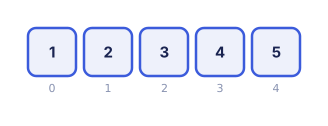
Example 1
Input: nums = [1,2,3,4,5]
Output: 15
Explanation: Select the entire array without deleting any element to obtain the maximum sum.
Example 2
Input: nums = [1,1,0,1,1]
Output: 1
Explanation: Delete the element nums[0] == 1 , nums[1] == 1 , nums[2] == 0 , and nums[3] == 1 . Select the entire array [1] to obtain the maximum sum.
Example 3
Input: nums = [1,2,-1,-2,1,0,-1]
Output: 3
Explanation: Delete the elements nums[2] == -1 and nums[3] == -2 , and select the subarray [2, 1] from [1, 2, 1, 0, -1] to obtain the maximum sum.
Constraints
- 1 <= nums.length <= 100
- -100 <= nums[i] <= 100
Hints
Companies
No companies reported yet.
Discussion
Sign in to join the discussion.
Loading discussion...
Test results
No test cases yet.