Minimum Adjacent Swaps to Reach the Kth Smallest Number
You are given a string num, representing a large integer, and an integer k.
You are given a string num, representing a large integer, and an integer k.
We call some integer wonderful if it is a permutation of the digits in num and is greater in value than num. There can be many wonderful integers. However, we only care about the smallest-valued ones.
Return the minimum number of adjacent digit swaps that needs to be applied to num to reach the kth smallest wonderful integer.
The tests are generated in such a way that kth smallest wonderful integer exists.
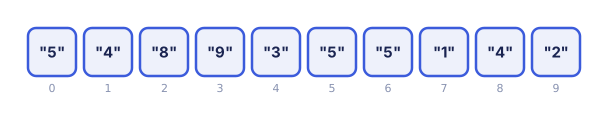
Example 1
Input: num = "5489355142", k = 4
Output: 2
Explanation: The 4th smallest wonderful number is "5489355421". To get this number: - Swap index 7 with index 8: "5489355142" -> "5489355412" - Swap index 8 with index 9: "5489355412" -> "5489355421"
Example 2
Input: num = "11112", k = 4
Output: 4
Explanation: The 4th smallest wonderful number is "21111". To get this number: - Swap index 3 with index 4: "11112" -> "11121" - Swap index 2 with index 3: "11121" -> "11211" - Swap index 1 with index 2: "11211" -> "12111" - Swap index 0 with index 1: "12111" -> "21111"
Example 3
Input: num = "00123", k = 1
Output: 1
Explanation: The 1st smallest wonderful number is "00132". To get this number: - Swap index 3 with index 4: "00123" -> "00132"
Constraints
- 2 <= num.length <= 1000
- 1 <= k <= 1000
- num only consists of digits.
Hints
Companies
No companies reported yet.
Discussion
Sign in to join the discussion.
Loading discussion...
Test results
No test cases yet.