Minimum Cost Path with Alternating Directions II
You are given two integers m and n representing the number of rows and columns of a grid, respectively.
You are given two integers m and n representing the number of rows and columns of a grid, respectively.
The cost to enter cell (i, j) is defined as (i + 1) * (j + 1).
You are also given a 2D integer array waitCost where waitCost[i][j] defines the cost to wait on that cell.
The path will always begin by entering cell (0, 0) on move 1 and paying the entrance cost.
At each step, you follow an alternating pattern:
Return the minimum total cost required to reach (m - 1, n - 1).
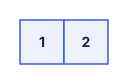
Example 1
Input: m = 1, n = 2, waitCost = [[1,2]]
Output: 3
Explanation: The optimal path is: Thus, the total cost is 1 + 2 = 3 .
Example 2
Input: m = 2, n = 2, waitCost = [[3,5],[2,4]]
Output: 9
Explanation: The optimal path is: Thus, the total cost is 1 + 2 + 2 + 4 = 9 .
Example 3
Input: m = 2, n = 3, waitCost = [[6,1,4],[3,2,5]]
Output: 16
Explanation: The optimal path is: Thus, the total cost is 1 + 2 + 1 + 4 + 2 + 6 = 16 .
Constraints
- 1 <= m, n <= 10^5
- 2 <= m * n <= 10^5
- waitCost.length == m
- waitCost[0].length == n
- 0 <= waitCost[i][j] <= 10^5
Hints
Companies
No companies reported yet.
Discussion
Sign in to join the discussion.
Loading discussion...
Test results
No test cases yet.