Minimum Increment Operations to Make Array Beautiful
You are given a 0-indexed integer array nums having length n, and an integer k.
You are given a 0-indexed integer array nums having length n, and an integer k.
You can perform the following increment operation any number of times (including zero):
An array is considered beautiful if, for any subarray with a size of 3 or more, its maximum element is greater than or equal to k.
Return an integer denoting the minimum number of increment operations needed to make nums beautiful.
A subarray is a contiguous non-empty sequence of elements within an array.
Example 1
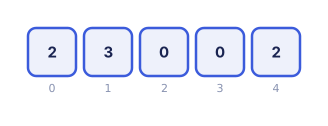
Input: nums = [2,3,0,0,2], k = 4
Output: 3
Explanation: We can perform the following increment operations to make nums beautiful: Choose index i = 1 and increase nums[1] by 1 -> [2,4,0,0,2]. Choose index i = 4 and increase nums[4] by 1 -> [2,4,0,0,3]. Choose index i = 4 and increase nums[4] by 1 -> [2,4,0,0,4]. The subarrays with a size of 3 or more are: [2,4,0], [4,0,0], [0,0,4], [2,4,0,0], [4,0,0,4], [2,4,0,0,4]. In all the subarrays, the maximum element is equal to k = 4, so nums is now beautiful. It can be shown that nums cannot be made beautiful with fewer than 3 increment operations. Hence, the answer is 3.
Example 2
Input: nums = [0,1,3,3], k = 5
Output: 2
Explanation: We can perform the following increment operations to make nums beautiful: Choose index i = 2 and increase nums[2] by 1 -> [0,1,4,3]. Choose index i = 2 and increase nums[2] by 1 -> [0,1,5,3]. The subarrays with a size of 3 or more are: [0,1,5], [1,5,3], [0,1,5,3]. In all the subarrays, the maximum element is equal to k = 5, so nums is now beautiful. It can be shown that nums cannot be made beautiful with fewer than 2 increment operations. Hence, the answer is 2.
Example 3
Input: nums = [1,1,2], k = 1
Output: 0
Explanation: The only subarray with a size of 3 or more in this example is [1,1,2]. The maximum element, 2, is already greater than k = 1, so we don't need any increment operation. Hence, the answer is 0.
Constraints
- 3 <= n == nums.length <= 10^5
- 0 <= nums[i] <= 10^9
- 0 <= k <= 10^9
Hints
Companies
No companies reported yet.
Discussion
Sign in to join the discussion.
Loading discussion...
Test results
No test cases yet.