Minimum Number of K Consecutive Bit Flips
You are given a binary array nums and an integer k.
You are given a binary array nums and an integer k.
A k-bit flip is choosing a subarray of length k from nums and simultaneously changing every 0 in the subarray to 1, and every 1 in the subarray to 0.
Return the minimum number of k-bit flips required so that there is no 0 in the array. If it is not possible, return -1.
A subarray is a contiguous part of an array.
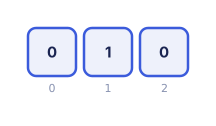
Example 1
Input: nums = [0,1,0], k = 1
Output: 2
Explanation: Flip nums[0], then flip nums[2].
Example 2
Input: nums = [1,1,0], k = 2
Output: -1
Explanation: No matter how we flip subarrays of size 2, we cannot make the array become [1,1,1].
Example 3
Input: nums = [0,0,0,1,0,1,1,0], k = 3
Output: 3
Explanation: Flip nums[0],nums[1],nums[2]: nums becomes [1,1,1,1,0,1,1,0] Flip nums[4],nums[5],nums[6]: nums becomes [1,1,1,1,1,0,0,0] Flip nums[5],nums[6],nums[7]: nums becomes [1,1,1,1,1,1,1,1]
Constraints
- 1 <= nums.length <= 10^5
- 1 <= k <= nums.length
Hints
No hints yet.
Companies
No companies reported yet.
Discussion
Sign in to join the discussion.
Loading discussion...
Test results
No test cases yet.