Minimum Operations to Convert Number
You are given a 0-indexed integer array nums containing distinct numbers, an integer start, and an integer goal.
You are given a 0-indexed integer array nums containing distinct numbers, an integer start, and an integer goal. There is an integer x that is initially set to start, and you want to perform operations on x such that it is converted to goal. You can perform the following operation repeatedly on the number x:
If 0 <= x <= 1000, then for any index i in the array (0 <= i < nums.length), you can set x to any of the following:
Note that you can use each nums[i] any number of times in any order. Operations that set x to be out of the range 0 <= x <= 1000 are valid, but no more operations can be done afterward.
Return the minimum number of operations needed to convert x = start into goal, and -1 if it is not possible.
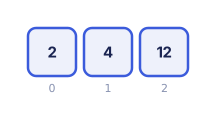
Example 1
Input: nums = [2,4,12], start = 2, goal = 12
Output: 2
Explanation: We can go from 2 → 14 → 12 with the following 2 operations. - 2 + 12 = 14 - 14 - 2 = 12
Example 2
Input: nums = [3,5,7], start = 0, goal = -4
Output: 2
Explanation: We can go from 0 → 3 → -4 with the following 2 operations. - 0 + 3 = 3 - 3 - 7 = -4 Note that the last operation sets x out of the range 0 <= x <= 1000, which is valid.
Example 3
Input: nums = [2,8,16], start = 0, goal = 1
Output: -1
Explanation: There is no way to convert 0 into 1.
Constraints
- 1 <= nums.length <= 1000
- -10^9 <= nums[i], goal <= 10^9
- 0 <= start <= 1000
- start != goal
- All the integers in nums are distinct.
Hints
Companies
No companies reported yet.
Discussion
Sign in to join the discussion.
Loading discussion...
Test results
No test cases yet.