Minimum Operations to Make the Array K-Increasing
You are given a 0-indexed array arr consisting of n positive integers, and a positive integer k.
You are given a 0-indexed array arr consisting of n positive integers, and a positive integer k.
The array arr is called K-increasing if arr[i-k] <= arr[i] holds for every index i, where k <= i <= n-1.
In one operation, you can choose an index i and change arr[i] into any positive integer.
Return the minimum number of operations required to make the array K-increasing for the given k.
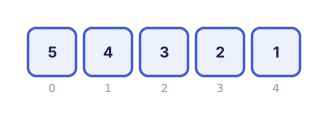
Example 1
Input: arr = [5,4,3,2,1], k = 1
Output: 4
Explanation: For k = 1, the resultant array has to be non-decreasing. Some of the K-increasing arrays that can be formed are [5,6,7,8,9], [1,1,1,1,1], [2,2,3,4,4]. All of them require 4 operations. It is suboptimal to change the array to, for example, [6,7,8,9,10] because it would take 5 operations. It can be shown that we cannot make the array K-increasing in less than 4 operations.
Example 2
Input: arr = [4,1,5,2,6,2], k = 2
Output: 0
Explanation: This is the same example as the one in the problem description. Here, for every index i where 2 <= i <= 5, arr[i-2] <= arr[i]. Since the given array is already K-increasing, we do not need to perform any operations.
Example 3
Input: arr = [4,1,5,2,6,2], k = 3
Output: 2
Explanation: Indices 3 and 5 are the only ones not satisfying arr[i-3] <= arr[i] for 3 <= i <= 5. One of the ways we can make the array K-increasing is by changing arr[3] to 4 and arr[5] to 5. The array will now be [4,1,5,4,6,5]. Note that there can be other ways to make the array K-increasing, but none of them require less than 2 operations.
Constraints
- 1 <= arr.length <= 10^5
- 1 <= arr[i], k <= arr.length
Hints
Companies
No companies reported yet.
Discussion
Sign in to join the discussion.
Loading discussion...
Test results
No test cases yet.