Minimum Suffix Flips
You are given a 0-indexed binary string target of length n.
You are given a 0-indexed binary string target of length n. You have another binary string s of length n that is initially set to all zeros. You want to make s equal to target.
In one operation, you can pick an index i where 0 <= i < n and flip all bits in the inclusive range [i, n - 1]. Flip means changing '0' to '1' and '1' to '0'.
Return the minimum number of operations needed to make s equal to target.
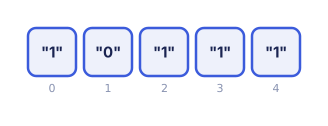
Example 1
Input: target = "10111"
Output: 3
Explanation: Initially, s = "00000". Choose index i = 2: "00000" -> "00111" Choose index i = 0: "00111" -> "11000" Choose index i = 1: "11000" -> "10111" We need at least 3 flip operations to form target.
Example 2
Input: target = "10^1"
Output: 3
Explanation: Initially, s = "000". Choose index i = 0: "000" -> "111" Choose index i = 1: "111" -> "100" Choose index i = 2: "100" -> "10^1" We need at least 3 flip operations to form target.
Example 3
Input: target = "00000"
Output: 0
Explanation: We do not need any operations since the initial s already equals target.
Constraints
- n == target.length
- 1 <= n <= 10^5
- target[i] is either '0' or '1'.
Hints
Companies
No companies reported yet.
Discussion
Sign in to join the discussion.
Loading discussion...
Test results
No test cases yet.