Moving Stones Until Consecutive II
There are some stones in different positions on the X-axis.
There are some stones in different positions on the X-axis. You are given an integer array stones, the positions of the stones.
Call a stone an endpoint stone if it has the smallest or largest position. In one move, you pick up an endpoint stone and move it to an unoccupied position so that it is no longer an endpoint stone.
The game ends when you cannot make any more moves (i.e., the stones are in three consecutive positions).
Return an integer array answer of length 2 where:
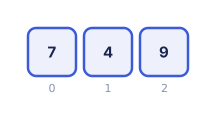
Example 1
Input: stones = [7,4,9]
Output: [1,2]
Explanation: We can move 4 -> 8 for one move to finish the game. Or, we can move 9 -> 5, 4 -> 6 for two moves to finish the game.
Example 2
Input: stones = [6,5,4,3,10]
Output: [2,3]
Explanation: We can move 3 -> 8 then 10 -> 7 to finish the game. Or, we can move 3 -> 7, 4 -> 8, 5 -> 9 to finish the game. Notice we cannot move 10 -> 2 to finish the game, because that would be an illegal move.
Constraints
- 3 <= stones.length <= 10^4
- 1 <= stones[i] <= 10^9
- All the values of stones are unique.
Hints
Companies
No companies reported yet.
Discussion
Sign in to join the discussion.
Loading discussion...
Test results
No test cases yet.