Number of Arithmetic Triplets
You are given a 0-indexed, strictly increasing integer array nums and a positive integer diff.
You are given a 0-indexed, strictly increasing integer array nums and a positive integer diff. A triplet (i, j, k) is an arithmetic triplet if the following conditions are met:
Return the number of unique arithmetic triplets.
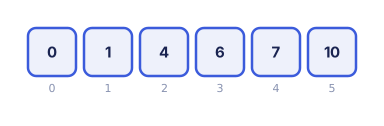
Example 1
Input: nums = [0,1,4,6,7,10], diff = 3
Output: 2
Explanation: (1, 2, 4) is an arithmetic triplet because both 7 - 4 == 3 and 4 - 1 == 3. (2, 4, 5) is an arithmetic triplet because both 10 - 7 == 3 and 7 - 4 == 3.
Example 2
Input: nums = [4,5,6,7,8,9], diff = 2
Output: 2
Explanation: (0, 2, 4) is an arithmetic triplet because both 8 - 6 == 2 and 6 - 4 == 2. (1, 3, 5) is an arithmetic triplet because both 9 - 7 == 2 and 7 - 5 == 2.
Constraints
- 3 <= nums.length <= 200
- 0 <= nums[i] <= 200
- 1 <= diff <= 50
- nums is strictly increasing.
Hints
Companies
No companies reported yet.
Discussion
Sign in to join the discussion.
Loading discussion...
Test results
No test cases yet.