Number of Excellent Pairs
You are given a 0-indexed positive integer array nums and a positive integer k.
You are given a 0-indexed positive integer array nums and a positive integer k.
A pair of numbers (num1, num2) is called excellent if the following conditions are satisfied:
Return the number of distinct excellent pairs.
Two pairs (a, b) and (c, d) are considered distinct if either a != c or b != d. For example, (1, 2) and (2, 1) are distinct.
Note that a pair (num1, num2) such that num1 == num2 can also be excellent if you have at least one occurrence of num1 in the array.
Example 1
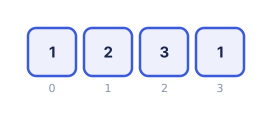
Input: nums = [1,2,3,1], k = 3
Output: 5
Explanation: The excellent pairs are the following: - (3, 3). (3 AND 3) and (3 OR 3) are both equal to (11) in binary. The total number of set bits is 2 + 2 = 4, which is greater than or equal to k = 3. - (2, 3) and (3, 2). (2 AND 3) is equal to (10) in binary, and (2 OR 3) is equal to (11) in binary. The total number of set bits is 1 + 2 = 3. - (1, 3) and (3, 1). (1 AND 3) is equal to (01) in binary, and (1 OR 3) is equal to (11) in binary. The total number of set bits is 1 + 2 = 3. So the number of excellent pairs is 5.
Example 2
Input: nums = [5,1,1], k = 10
Output: 0
Explanation: There are no excellent pairs for this array.
Constraints
- 1 <= nums.length <= 10^5
- 1 <= nums[i] <= 10^9
- 1 <= k <= 60
Hints
Companies
No companies reported yet.
Discussion
Sign in to join the discussion.
Loading discussion...
Test results
No test cases yet.