Number of Times Binary String Is Prefix-Aligned
You have a 1-indexed binary string of length n where all the bits are 0 initially.
You have a 1-indexed binary string of length n where all the bits are 0 initially. We will flip all the bits of this binary string (i.e., change them from 0 to 1) one by one. You are given a 1-indexed integer array flips where flips[i] indicates that the bit at index flips[i] will be flipped in the ith step.
A binary string is prefix-aligned if, after the ith step, all the bits in the inclusive range [1, i] are ones and all the other bits are zeros.
Return the number of times the binary string is prefix-aligned during the flipping process.
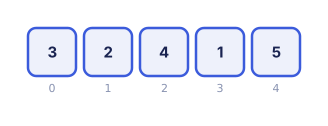
Example 1
Input: flips = [3,2,4,1,5]
Output: 2
Explanation: The binary string is initially "00000". After applying step 1: The string becomes "00100", which is not prefix-aligned. After applying step 2: The string becomes "01100", which is not prefix-aligned. After applying step 3: The string becomes "01110", which is not prefix-aligned. After applying step 4: The string becomes "11110", which is prefix-aligned. After applying step 5: The string becomes "11111", which is prefix-aligned. We can see that the string was prefix-aligned 2 times, so we return 2.
Example 2
Input: flips = [4,1,2,3]
Output: 1
Explanation: The binary string is initially "0000". After applying step 1: The string becomes "0001", which is not prefix-aligned. After applying step 2: The string becomes "1001", which is not prefix-aligned. After applying step 3: The string becomes "1101", which is not prefix-aligned. After applying step 4: The string becomes "1111", which is prefix-aligned. We can see that the string was prefix-aligned 1 time, so we return 1.
Constraints
- n == flips.length
- 1 <= n <= 5 * 10^4
- flips is a permutation of the integers in the range [1, n].
Hints
Companies
No companies reported yet.
Discussion
Sign in to join the discussion.
Loading discussion...
Test results
No test cases yet.