Pancake Sorting
Given an array of integers arr, sort the array by performing a series of pancake flips.
Given an array of integers arr, sort the array by performing a series of pancake flips.
In one pancake flip we do the following steps:
For example, if arr = [3,2,1,4] and we performed a pancake flip choosing k = 3, we reverse the sub-array [3,2,1], so arr = [1,2,3,4] after the pancake flip at k = 3.
Return an array of the k-values corresponding to a sequence of pancake flips that sort arr. Any valid answer that sorts the array within 10 * arr.length flips will be judged as correct.
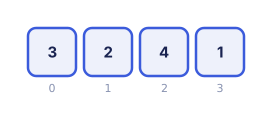
Example 1
Input: arr = [3,2,4,1]
Output: [4,2,4,3]
Explanation: We perform 4 pancake flips, with k values 4, 2, 4, and 3. Starting state: arr = [3, 2, 4, 1] After 1st flip (k = 4): arr = [1, 4, 2, 3] After 2nd flip (k = 2): arr = [4, 1, 2, 3] After 3rd flip (k = 4): arr = [3, 2, 1, 4] After 4th flip (k = 3): arr = [1, 2, 3, 4], which is sorted.
Example 2
Input: arr = [1,2,3]
Output: []
Explanation: The input is already sorted, so there is no need to flip anything. Note that other answers, such as [3, 3], would also be accepted.
Constraints
- 1 <= arr.length <= 100
- 1 <= arr[i] <= arr.length
- All integers in arr are unique (i.e. arr is a permutation of the integers from 1 to arr.length).
Hints
No hints yet.
Companies
No companies reported yet.
Discussion
Sign in to join the discussion.
Loading discussion...
Test results
No test cases yet.