Partition Array for Maximum XOR and AND
You are given an integer array nums.
You are given an integer array nums.
Partition the array into three (possibly empty) subsequences A, B, and C such that every element of nums belongs to exactly one subsequence.
Your goal is to maximize the value of: XOR(A) + AND(B) + XOR(C)
where:
Return the maximum value achievable.
Note: If multiple partitions result in the same maximum sum, you can consider any one of them.
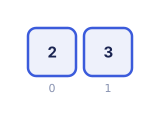
Example 1
Input: nums = [2,3]
Output: 5
Explanation: One optimal partition is: The maximum value of: XOR(A) + AND(B) + XOR(C) = 3 + 2 + 0 = 5 . Thus, the answer is 5.
Example 2
Input: nums = [1,3,2]
Output: 6
Explanation: One optimal partition is: The maximum value of: XOR(A) + AND(B) + XOR(C) = 1 + 2 + 3 = 6 . Thus, the answer is 6.
Example 3
Input: nums = [2,3,6,7]
Output: 15
Explanation: One optimal partition is: The maximum value of: XOR(A) + AND(B) + XOR(C) = 7 + 2 + 6 = 15 . Thus, the answer is 15.
Constraints
- 1 <= nums.length <= 19
- 1 <= nums[i] <= 10^9
Hints
Companies
No companies reported yet.
Discussion
Sign in to join the discussion.
Loading discussion...
Test results
No test cases yet.