Prison Cells After N Days
There are 8 prison cells in a row and each cell is either occupied or vacant.
There are 8 prison cells in a row and each cell is either occupied or vacant.
Each day, whether the cell is occupied or vacant changes according to the following rules:
Note that because the prison is a row, the first and the last cells in the row can't have two adjacent neighbors.
You are given an integer array cells where cells[i] == 1 if the ith cell is occupied and cells[i] == 0 if the ith cell is vacant, and you are given an integer n.
Return the state of the prison after n days (i.e., n such changes described above).
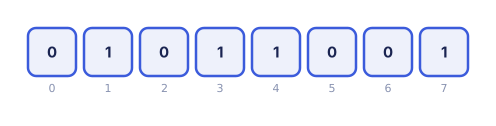
Example 1
Input: cells = [0,1,0,1,1,0,0,1], n = 7
Output: [0,0,1,1,0,0,0,0]
Explanation: The following table summarizes the state of the prison on each day: Day 0: [0, 1, 0, 1, 1, 0, 0, 1] Day 1: [0, 1, 1, 0, 0, 0, 0, 0] Day 2: [0, 0, 0, 0, 1, 1, 1, 0] Day 3: [0, 1, 1, 0, 0, 1, 0, 0] Day 4: [0, 0, 0, 0, 0, 1, 0, 0] Day 5: [0, 1, 1, 1, 0, 1, 0, 0] Day 6: [0, 0, 1, 0, 1, 1, 0, 0] Day 7: [0, 0, 1, 1, 0, 0, 0, 0]
Example 2
Input: cells = [1,0,0,1,0,0,1,0], n = 1000000000
Output: [0,0,1,1,1,1,1,0]
Constraints
- cells.length == 8
- cells[i] is either 0 or 1.
- 1 <= n <= 10^9
Hints
No hints yet.
Companies
No companies reported yet.
Discussion
Sign in to join the discussion.
Loading discussion...
Test results
No test cases yet.