Queries on a Permutation With Key
Given the array queries of positive integers between 1 and m, you have to process all queries[i] (from i=0 to i=queries.length-1) according to the following rules: Return an array...
Given the array queries of positive integers between 1 and m, you have to process all queries[i] (from i=0 to i=queries.length-1) according to the following rules:
Return an array containing the result for the given queries.
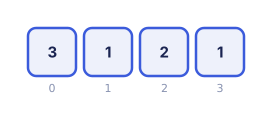
Example 1
Input: queries = [3,1,2,1], m = 5
Output: [2,1,2,1]
Explanation: The queries are processed as follow: For i=0: queries[i]=3, P=[1,2,3,4,5], position of 3 in P is 2, then we move 3 to the beginning of P resulting in P=[3,1,2,4,5]. For i=1: queries[i]=1, P=[3,1,2,4,5], position of 1 in P is 1, then we move 1 to the beginning of P resulting in P=[1,3,2,4,5]. For i=2: queries[i]=2, P=[1,3,2,4,5], position of 2 in P is 2, then we move 2 to the beginning of P resulting in P=[2,1,3,4,5]. For i=3: queries[i]=1, P=[2,1,3,4,5], position of 1 in P is 1, then we move 1 to the beginning of P resulting in P=[1,2,3,4,5]. Therefore, the array containing the result is [2,1,2,1].
Example 2
Input: queries = [4,1,2,2], m = 4
Output: [3,1,2,0]
Example 3
Input: queries = [7,5,5,8,3], m = 8
Output: [6,5,0,7,5]
Constraints
- 1 <= m <= 10^3
- 1 <= queries.length <= m
- 1 <= queries[i] <= m
Hints
Companies
No companies reported yet.
Discussion
Sign in to join the discussion.
Loading discussion...
Test results
No test cases yet.