Remove Outermost Parentheses
A valid parentheses string is either empty "", "(" + A + ")", or A + B, where A and B are valid parentheses strings, and + represents string concatenation.
A valid parentheses string is either empty "", "(" + A + ")", or A + B, where A and B are valid parentheses strings, and + represents string concatenation.
A valid parentheses string s is primitive if it is nonempty, and there does not exist a way to split it into s = A + B, with A and B nonempty valid parentheses strings.
Given a valid parentheses string s, consider its primitive decomposition: s = P1 + P2 + ... + Pk, where Pi are primitive valid parentheses strings.
Return s after removing the outermost parentheses of every primitive string in the primitive decomposition of s.
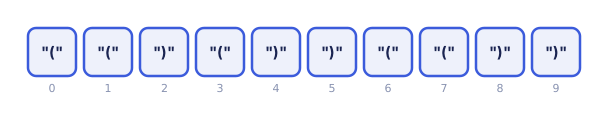
Example 1
Input: s = "(()())(())"
Output: "()()()"
Explanation: The input string is "(()())(())", with primitive decomposition "(()())" + "(())". After removing outer parentheses of each part, this is "()()" + "()" = "()()()".
Example 2
Input: s = "(()())(())(()(()))"
Output: "()()()()(())"
Explanation: The input string is "(()())(())(()(()))", with primitive decomposition "(()())" + "(())" + "(()(()))". After removing outer parentheses of each part, this is "()()" + "()" + "()(())" = "()()()()(())".
Example 3
Input: s = "()()"
Output: ""
Explanation: The input string is "()()", with primitive decomposition "()" + "()". After removing outer parentheses of each part, this is "" + "" = "".
Constraints
- 1 <= s.length <= 10^5
- s[i] is either '(' or ')'.
- s is a valid parentheses string.
Hints
Companies
No companies reported yet.
Discussion
Sign in to join the discussion.
Loading discussion...
Test results
No test cases yet.