Semi-Ordered Permutation
You are given a 0-indexed permutation of n integers nums.
You are given a 0-indexed permutation of n integers nums.
A permutation is called semi-ordered if the first number equals 1 and the last number equals n. You can perform the below operation as many times as you want until you make nums a semi-ordered permutation:
Return the minimum number of operations to make nums a semi-ordered permutation.
A permutation is a sequence of integers from 1 to n of length n containing each number exactly once.
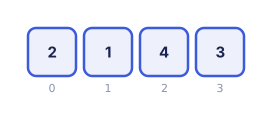
Example 1
Input: nums = [2,1,4,3]
Output: 2
Explanation: We can make the permutation semi-ordered using these sequence of operations: 1 - swap i = 0 and j = 1. The permutation becomes [1,2,4,3]. 2 - swap i = 2 and j = 3. The permutation becomes [1,2,3,4]. It can be proved that there is no sequence of less than two operations that make nums a semi-ordered permutation.
Example 2
Input: nums = [2,4,1,3]
Output: 3
Explanation: We can make the permutation semi-ordered using these sequence of operations: 1 - swap i = 1 and j = 2. The permutation becomes [2,1,4,3]. 2 - swap i = 0 and j = 1. The permutation becomes [1,2,4,3]. 3 - swap i = 2 and j = 3. The permutation becomes [1,2,3,4]. It can be proved that there is no sequence of less than three operations that make nums a semi-ordered permutation.
Example 3
Input: nums = [1,3,4,2,5]
Output: 0
Explanation: The permutation is already a semi-ordered permutation.
Constraints
- 2 <= nums.length == n <= 50
- 1 <= nums[i] <= 50
- nums is a permutation.
Hints
Companies
No companies reported yet.
Discussion
Sign in to join the discussion.
Loading discussion...
Test results
No test cases yet.