Shortest Distance After Road Addition Queries II
You are given an integer n and a 2D integer array queries.
You are given an integer n and a 2D integer array queries.
There are n cities numbered from 0 to n - 1. Initially, there is a unidirectional road from city i to city i + 1 for all 0 <= i < n - 1.
queries[i] = [ui, vi] represents the addition of a new unidirectional road from city ui to city vi. After each query, you need to find the length of the shortest path from city 0 to city n - 1.
There are no two queries such that queries[i][0] < queries[j][0] < queries[i][1] < queries[j][1].
Return an array answer where for each i in the range [0, queries.length - 1], answer[i] is the length of the shortest path from city 0 to city n - 1 after processing the first i + 1 queries.
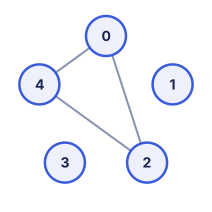
Example 1
Input: n = 5, queries = [[2,4],[0,2],[0,4]]
Output: [3,2,1]
Explanation: After the addition of the road from 2 to 4, the length of the shortest path from 0 to 4 is 3. After the addition of the road from 0 to 2, the length of the shortest path from 0 to 4 is 2. After the addition of the road from 0 to 4, the length of the shortest path from 0 to 4 is 1.
Example 2
Input: n = 4, queries = [[0,3],[0,2]]
Output: [1,1]
Explanation: After the addition of the road from 0 to 3, the length of the shortest path from 0 to 3 is 1. After the addition of the road from 0 to 2, the length of the shortest path remains 1.
Constraints
- 3 <= n <= 10^5
- 1 <= queries.length <= 10^5
- queries[i].length == 2
- 0 <= queries[i][0] < queries[i][1] < n
- 1 < queries[i][1] - queries[i][0]
- There are no repeated roads among the queries.
- There are no two queries such that i != j and queries[i][0] < queries[j][0] < queries[i][1] < queries[j][1].
Hints
No hints yet.
Companies
No companies reported yet.
Discussion
Sign in to join the discussion.
Loading discussion...
Test results
No test cases yet.