Sliding Subarray Beauty
Given an integer array nums containing n integers, find the beauty of each subarray of size k.
Given an integer array nums containing n integers, find the beauty of each subarray of size k.
The beauty of a subarray is the xth smallest integer in the subarray if it is negative, or 0 if there are fewer than x negative integers.
Return an integer array containing n - k + 1 integers, which denote the beauty of the subarrays in order from the first index in the array.
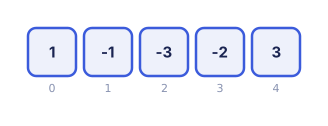
Example 1
Input: nums = [1,-1,-3,-2,3], k = 3, x = 2
Output: [-1,-2,-2]
Explanation: There are 3 subarrays with size k = 3. The first subarray is [1, -1, -3] and the 2nd smallest negative integer is -1. The second subarray is [-1, -3, -2] and the 2nd smallest negative integer is -2. The third subarray is [-3, -2, 3] and the 2nd smallest negative integer is -2.
Example 2
Input: nums = [-1,-2,-3,-4,-5], k = 2, x = 2
Output: [-1,-2,-3,-4]
Explanation: There are 4 subarrays with size k = 2. For [-1, -2], the 2nd smallest negative integer is -1. For [-2, -3], the 2nd smallest negative integer is -2. For [-3, -4], the 2nd smallest negative integer is -3. For [-4, -5], the 2nd smallest negative integer is -4.
Example 3
Input: nums = [-3,1,2,-3,0,-3], k = 2, x = 1
Output: [-3,0,-3,-3,-3]
Explanation: There are 5 subarrays with size k = 2. For [-3, 1], the 1st smallest negative integer is -3. For [1, 2], there is no negative integer so the beauty is 0. For [2, -3], the 1st smallest negative integer is -3. For [-3, 0], the 1st smallest negative integer is -3. For [0, -3], the 1st smallest negative integer is -3.
Constraints
- n == nums.length
- 1 <= n <= 10^5
- 1 <= k <= n
- 1 <= x <= k
- -50 <= nums[i] <= 50
Hints
Companies
No companies reported yet.
Discussion
Sign in to join the discussion.
Loading discussion...
Test results
No test cases yet.