Smallest Divisible Digit Product II
You are given a string num which represents a positive integer, and an integer t.
You are given a string num which represents a positive integer, and an integer t.
A number is called zero-free if none of its digits are 0.
Return a string representing the smallest zero-free number greater than or equal to num such that the product of its digits is divisible by t. If no such number exists, return "-1".
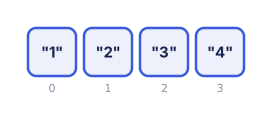
Example 1
Input: num = "1234", t = 256
Output: "1488"
Explanation: The smallest zero-free number that is greater than 1234 and has the product of its digits divisible by 256 is 1488, with the product of its digits equal to 256.
Example 2
Input: num = "12355", t = 50
Output: "12355"
Explanation: 12355 is already zero-free and has the product of its digits divisible by 50, with the product of its digits equal to 150.
Example 3
Input: num = "11111", t = 26
Output: "-1"
Explanation: No number greater than 11111 has the product of its digits divisible by 26.
Constraints
- 2 <= num.length <= 2 * 10^5
- num consists only of digits in the range ['0', '9'].
- num does not contain leading zeros.
- 1 <= t <= 1014
Hints
Companies
No companies reported yet.
Discussion
Sign in to join the discussion.
Loading discussion...
Test results
No test cases yet.