Smallest Missing Non-negative Integer After Operations
You are given a 0-indexed integer array nums and an integer value.
You are given a 0-indexed integer array nums and an integer value.
In one operation, you can add or subtract value from any element of nums.
The MEX (minimum excluded) of an array is the smallest missing non-negative integer in it.
Return the maximum MEX of nums after applying the mentioned operation any number of times.
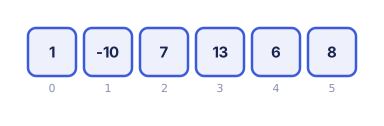
Example 1
Input: nums = [1,-10,7,13,6,8], value = 5
Output: 4
Explanation: One can achieve this result by applying the following operations: - Add value to nums[1] twice to make nums = [1,0,7,13,6,8] - Subtract value from nums[2] once to make nums = [1,0,2,13,6,8] - Subtract value from nums[3] twice to make nums = [1,0,2,3,6,8] The MEX of nums is 4. It can be shown that 4 is the maximum MEX we can achieve.
Example 2
Input: nums = [1,-10,7,13,6,8], value = 7
Output: 2
Explanation: One can achieve this result by applying the following operation: - subtract value from nums[2] once to make nums = [1,-10,0,13,6,8] The MEX of nums is 2. It can be shown that 2 is the maximum MEX we can achieve.
Constraints
- 1 <= nums.length, value <= 10^5
- -10^9 <= nums[i] <= 10^9
Hints
Companies
No companies reported yet.
Discussion
Sign in to join the discussion.
Loading discussion...
Test results
No test cases yet.