Sum of Subsequence Widths
The width of a sequence is the difference between the maximum and minimum elements in the sequence.
The width of a sequence is the difference between the maximum and minimum elements in the sequence.
Given an array of integers nums, return the sum of the widths of all the non-empty subsequences of nums. Since the answer may be very large, return it modulo 10^9 + 7.
A subsequence is a sequence that can be derived from an array by deleting some or no elements without changing the order of the remaining elements. For example, [3,6,2,7] is a subsequence of the array [0,3,1,6,2,2,7].
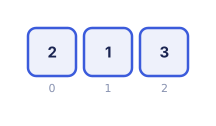
Example 1
Input: nums = [2,1,3]
Output: 6
Explanation: The subsequences are [1], [2], [3], [2,1], [2,3], [1,3], [2,1,3]. The corresponding widths are 0, 0, 0, 1, 1, 2, 2. The sum of these widths is 6.
Example 2
Input: nums = [2]
Output: 0
Constraints
- 1 <= nums.length <= 10^5
- 1 <= nums[i] <= 10^5
Hints
No hints yet.
Companies
No companies reported yet.
Discussion
Sign in to join the discussion.
Loading discussion...
Test results
No test cases yet.