Task Scheduler II
You are given a 0-indexed array of positive integers tasks, representing tasks that need to be completed in order, where tasks[i] represents the type of the ith task.
You are given a 0-indexed array of positive integers tasks, representing tasks that need to be completed in order, where tasks[i] represents the type of the ith task.
You are also given a positive integer space, which represents the minimum number of days that must pass after the completion of a task before another task of the same type can be performed.
Each day, until all tasks have been completed, you must either:
Return the minimum number of days needed to complete all tasks.
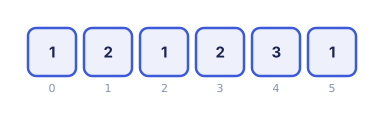
Example 1
Input: tasks = [1,2,1,2,3,1], space = 3
Output: 9
Explanation: One way to complete all tasks in 9 days is as follows: Day 1: Complete the 0th task. Day 2: Complete the 1st task. Day 3: Take a break. Day 4: Take a break. Day 5: Complete the 2nd task. Day 6: Complete the 3rd task. Day 7: Take a break. Day 8: Complete the 4th task. Day 9: Complete the 5th task. It can be shown that the tasks cannot be completed in less than 9 days.
Example 2
Input: tasks = [5,8,8,5], space = 2
Output: 6
Explanation: One way to complete all tasks in 6 days is as follows: Day 1: Complete the 0th task. Day 2: Complete the 1st task. Day 3: Take a break. Day 4: Take a break. Day 5: Complete the 2nd task. Day 6: Complete the 3rd task. It can be shown that the tasks cannot be completed in less than 6 days.
Constraints
- 1 <= tasks.length <= 10^5
- 1 <= tasks[i] <= 10^9
- 1 <= space <= tasks.length
Hints
Companies
No companies reported yet.
Discussion
Sign in to join the discussion.
Loading discussion...
Test results
No test cases yet.