Total Appeal of A String
The appeal of a string is the number of distinct characters found in the string.
The appeal of a string is the number of distinct characters found in the string.
Given a string s, return the total appeal of all of its substrings.
A substring is a contiguous sequence of characters within a string.
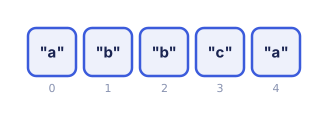
Example 1
Input: s = "abbca"
Output: 28
Explanation: The following are the substrings of "abbca": - Substrings of length 1: "a", "b", "b", "c", "a" have an appeal of 1, 1, 1, 1, and 1 respectively. The sum is 5. - Substrings of length 2: "ab", "bb", "bc", "ca" have an appeal of 2, 1, 2, and 2 respectively. The sum is 7. - Substrings of length 3: "abb", "bbc", "bca" have an appeal of 2, 2, and 3 respectively. The sum is 7. - Substrings of length 4: "abbc", "bbca" have an appeal of 3 and 3 respectively. The sum is 6. - Substrings of length 5: "abbca" has an appeal of 3. The sum is 3. The total sum is 5 + 7 + 7 + 6 + 3 = 28.
Example 2
Input: s = "code"
Output: 20
Explanation: The following are the substrings of "code": - Substrings of length 1: "c", "o", "d", "e" have an appeal of 1, 1, 1, and 1 respectively. The sum is 4. - Substrings of length 2: "co", "od", "de" have an appeal of 2, 2, and 2 respectively. The sum is 6. - Substrings of length 3: "cod", "ode" have an appeal of 3 and 3 respectively. The sum is 6. - Substrings of length 4: "code" has an appeal of 4. The sum is 4. The total sum is 4 + 6 + 6 + 4 = 20.
Constraints
- 1 <= s.length <= 10^5
- s consists of lowercase English letters.
Hints
Companies
No companies reported yet.
Discussion
Sign in to join the discussion.
Loading discussion...
Test results
No test cases yet.