Unique Paths III
You are given an m x n integer array grid where grid[i][j] could be: Return the number of 4-directional walks from the starting square to the ending square, that walk over every...
You are given an m x n integer array grid where grid[i][j] could be:
Return the number of 4-directional walks from the starting square to the ending square, that walk over every non-obstacle square exactly once.
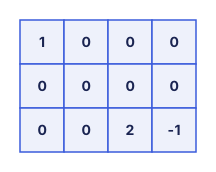
Example 1
Input: grid = [[1,0,0,0],[0,0,0,0],[0,0,2,-1]]
Output: 2
Explanation: We have the following two paths: 1. (0,0),(0,1),(0,2),(0,3),(1,3),(1,2),(1,1),(1,0),(2,0),(2,1),(2,2) 2. (0,0),(1,0),(2,0),(2,1),(1,1),(0,1),(0,2),(0,3),(1,3),(1,2),(2,2)
Example 2
Input: grid = [[1,0,0,0],[0,0,0,0],[0,0,0,2]]
Output: 4
Explanation: We have the following four paths: 1. (0,0),(0,1),(0,2),(0,3),(1,3),(1,2),(1,1),(1,0),(2,0),(2,1),(2,2),(2,3) 2. (0,0),(0,1),(1,1),(1,0),(2,0),(2,1),(2,2),(1,2),(0,2),(0,3),(1,3),(2,3) 3. (0,0),(1,0),(2,0),(2,1),(2,2),(1,2),(1,1),(0,1),(0,2),(0,3),(1,3),(2,3) 4. (0,0),(1,0),(2,0),(2,1),(1,1),(0,1),(0,2),(0,3),(1,3),(1,2),(2,2),(2,3)
Example 3
Input: grid = [[0,1],[2,0]]
Output: 0
Explanation: There is no path that walks over every empty square exactly once. Note that the starting and ending square can be anywhere in the grid.
Constraints
- m == grid.length
- n == grid[i].length
- 1 <= m, n <= 20
- 1 <= m * n <= 20
- -1 <= grid[i][j] <= 2
- There is exactly one starting cell and one ending cell.
Hints
No hints yet.
Companies
No companies reported yet.
Discussion
Sign in to join the discussion.
Loading discussion...
Test results
No test cases yet.